
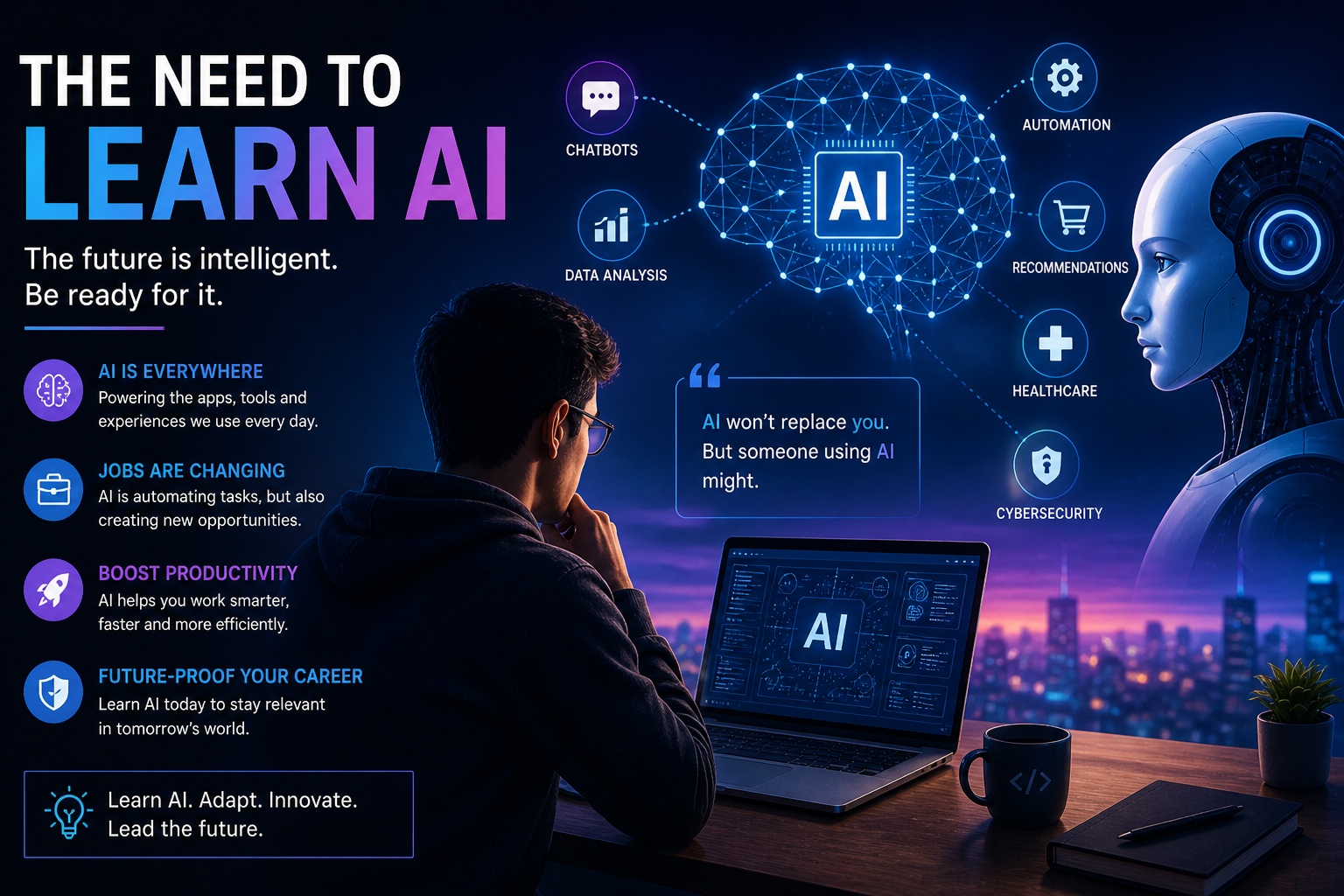
Artificial intelligence is no longer a futuristic concept reserved for science fiction films or Silicon Valley boardrooms. It is here, it is real, and it is quietly and sometimes loudly, transforming every industry it touches. From healthcare to finance, education to agriculture, AI is rewriting the rules of how work gets done. The question is no longer whether AI will affect your career. The question is how prepared you are when it does.
What exactly is artificial intelligence?
At its core, Artificial Intelligence (AI) refers to computer systems designed to perform tasks that would normally require human intelligence. These include understanding natural language, recognising patterns, making decisions, solving complex problems, and even learning from experience.
Unlike traditional software that follows fixed rules, modern AI systems, powered by machine learning and deep learning, improve over time. The more data they process, the smarter they become. This is what makes AI so powerful, and in some cases, so disruptive.
Jobs AI is Already Taking
Let's be honest about something most people avoid saying out loud: AI is already replacing jobs, and it will replace more. This is not a distant warning — it is happening right now.
- Data Entry and Administrative Roles
Repetitive, rule-based tasks are the first to go. AI-powered tools can process thousands of forms, invoices, and records in minutes, work that once required entire departments.
- Customer Service
Chatbots and virtual assistants now handle millions of customer queries daily. Many companies have significantly reduced their human support teams as a result.
- Manufacturing and Logistics
Robots guided by AI now assemble products, manage warehouses, and optimise supply chains with a level of precision and speed no human workforce can match consistently.
- Content and Creative Work
AI writing tools, image generators, and video editors are beginning to compete with human creatives — producing marketing copy, social media content, and even news articles at scale.
- Financial Analysis
AI algorithms analyse market trends, assess credit risks, and execute trades faster than any human analyst. Many junior finance roles are quietly disappearing.
AI Is Also Creating New Opportunities
Here is what often gets left out of the conversation: while AI eliminates certain jobs, it simultaneously creates new ones, and expands others.
- AI Trainers and Prompt Engineers — people who teach AI systems how to behave and what to produce.
- AI Ethics and Policy Specialists — professionals who ensure AI is used responsibly and fairly.
- Data Scientists and ML Engineers — the architects behind the systems driving this revolution.
- AI Integration Consultants — experts who help businesses adopt and implement AI tools effectively.
- Human-AI Collaboration Roles — jobs that combine human judgement with AI efficiency, which no machine can fully replace.
The World Economic Forum estimates that while AI may displace 85 million jobs by 2025, it could also create 97 million new roles. The net result could be positive, but only for those who are prepared.
Why You Need to Learn AI Now
Waiting is not a neutral decision. Every month you delay, the gap between AI-ready professionals and everyone else widens. Here is why now is the most important time to start:
- AI Literacy Is Becoming a Basic Workplace Skill
Just as knowing how to use a computer became expected in the 1990s, understanding AI tools is rapidly becoming a baseline expectation across industries, not just in tech.
2. Early Movers Have the Advantage
Those who learn AI skills now will be the ones training others, leading teams, and commanding higher salaries in the years ahead. The early advantage in a rapidly growing field is enormous.
3. AI Won't Replace You — Someone Using AI Will
This has become one of the most repeated truths in modern career advice, because it is accurate. Professionals who leverage AI tools work faster, produce more, and deliver better results than those who do not.
4. The Learning Curve Is Smaller Than You Think
You do not need a computer science degree to get started. Tools like ChatGPT, Midjourney, GitHub Copilot, and Google Gemini are designed to be accessible. Understanding how to use them effectively is a skill anyone can develop.
Where to Start Your AI Learning Journey
If you are ready to take action, here are practical first steps:
- Understand the basics — take a free course on AI fundamentals from platforms like Coursera, edX, or Google's AI learning hub.
- Explore AI tools in your field — every industry now has AI tools tailored to it. Find out which ones are most relevant to your work.
- Practice prompt engineering — learning how to communicate effectively with AI tools is one of the highest-leverage skills you can develop right now.
- Stay informed — follow AI news, read research summaries, and join communities where professionals discuss how AI is changing their industries.
- Build projects — the best way to learn is by doing. Use AI to solve a real problem in your life or work.
It is not the enemy of human potential; it is a multiplier of it. But like any powerful tool, it benefits those who understand and use it, while leaving behind those who ignore it.
The jobs market of 2030 will look significantly different from today. The professionals who will thrive are not necessarily the smartest or the most experienced; they are the ones who started learning, adapting, and building AI skills early enough to stay ahead of the curve.
The best time to start was yesterday. The second best time is right now.